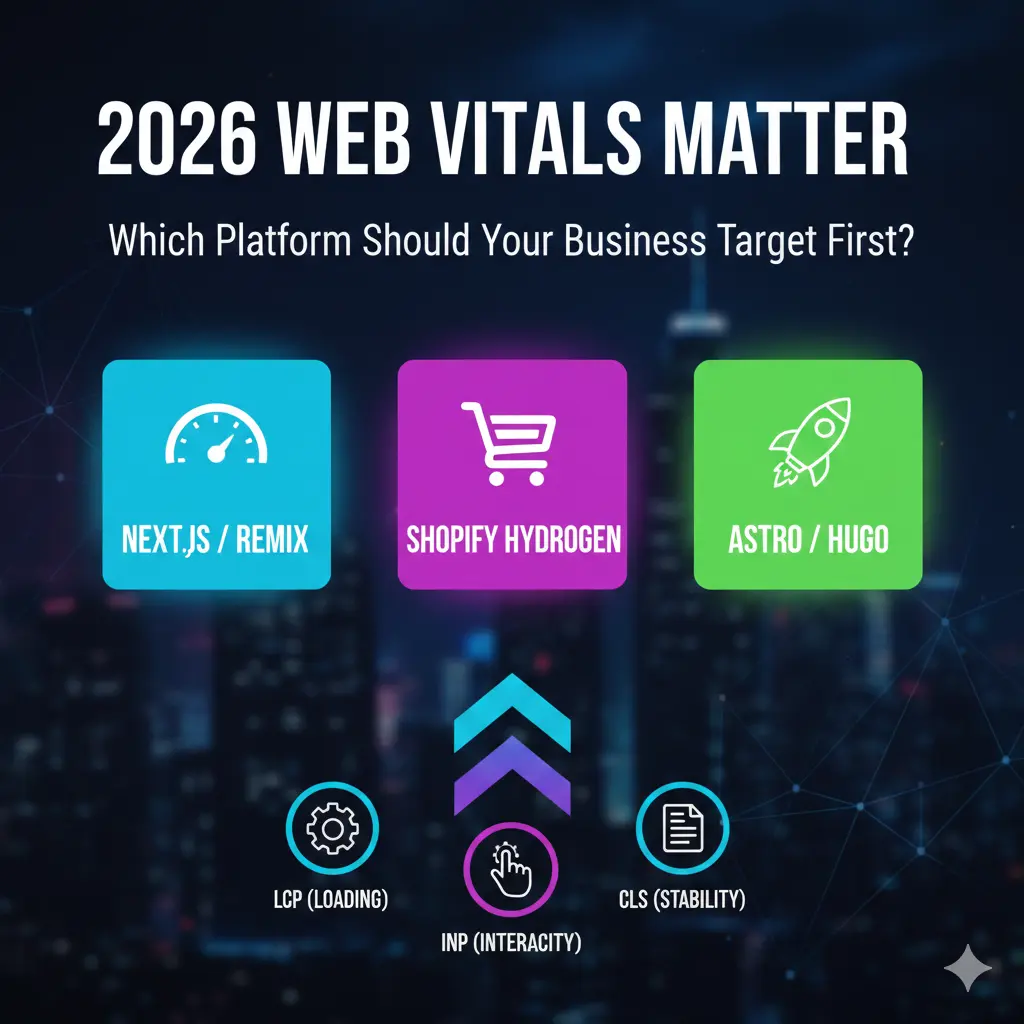

In 2026, the internet is no longer just a collection of pages; it is a high-speed ecosystem of instant expectations. Google’s Core Web Vitals (CWV) have evolved from technical "nice-to-haves" into the primary gatekeepers of digital visibility and customer trust. For a business in 2026, failing these metrics isn't just a developer's headache—it’s a direct hit to the bottom line.
Whether you are launching a high-growth startup or migrating a legacy enterprise, the platform you build on dictates your "performance ceiling." Here is the 2026 guide to prioritizing Web Vitals and choosing the platform that will keep your business in the green.
In 2026, Google’s AI-driven ranking systems don't just ask "Is it fast?" They ask "Does it feel effortless?" The three pillars of Core Web Vitals have matured, with one significant new king on the throne:
LCP (Largest Contentful Paint): Loading Performance. The target is now strictly under 2.5 seconds. In 2026, this accounts for background images and dynamic AI-generated content.
INP (Interaction to Next Paint): Interactivity. Replacing the old FID, INP is the "responsiveness" metric. A "good" score is under 200ms, but top-tier competitive sites in 2026 are targeting 150ms.
CLS (Cumulative Layout Shift): Visual Stability. The standard remains 0.1 or less. In a world of dynamic ads and shifting video feeds, visual stability is the #1 builder of user trust.
If your business depends on SEO Traffic and Search Intent Alignment, building on a modern JavaScript framework is your best move.
Why: These platforms are "Performance First" by design. They offer Server-Side Rendering (SSR) and Edge Functions, which slash your LCP by delivering content from a server physically close to the user.
The 2026 Edge: Next.js 16+ has built-in AI optimizations that automatically "chunk" your code to ensure your INP remains low even on low-end mobile devices.
Best For: SaaS platforms, content hubs, and high-competition SEO niches.
For Retail and E-commerce, the "monolithic" stores of the past are a Web Vitals nightmare. Headless is the 2026 standard.
Why: By decoupling the "head" (what the user sees) from the "body" (the checkout engine), you can optimize the front-end for 100/100 performance scores without being slowed down by heavy backend scripts.
The 2026 Edge: Shopify's Oxygen hosting allows for sub-second LCP even with high-resolution 3D product models.
Best For: Global retail brands and high-volume dropshipping.
If your site is content-heavy but doesn't require complex user logins (like a blog, portfolio, or documentation), go static.
Why: Astro’s "Island Architecture" only loads the JavaScript for interactive parts of the page. This is the ultimate "cheat code" for perfect INP and LCP.
Best For: Marketing sites, technical documentation, and non-transactional business sites.
Metric | Impact of "Good" Score | Impact of "Poor" Score |
LCP | +15% SEO Traffic Increase | High Bounce Rates (53% leave after 3s) |
INP | Higher Conversion (Frictionless UI) | Users abandon carts due to "laggy" feel |
CLS | High Brand Trust & Professionalism | Users click the wrong button (Frustration) |
A major reason Web Vitals matter even more in 2026 is AI Overviews (SGE). Google’s AI agents are programmed to cite and recommend websites that are easy to crawl and fast to load. If your site has poor Web Vitals, it effectively becomes "invisible" to the AI engines that provide answers to millions of users daily.
Ask yourself these three strategic questions:
Is your primary growth driver Search (Google)?
Target Next.js or Remix. Their tight integration with Vercel/Netlify edge networks ensures your LCP is always in the green.
Is your site a complex e-commerce engine?
Target Shopify Hydrogen. It’s the only platform in 2026 that balances extreme "Web Vital" speed with the heavy lifting of a global checkout system.
Do you have a limited dev budget?
Target Astro. It’s easier to maintain and gives you "free" performance out of the box without complex optimization cycles.
In 2026, Core Web Vitals are the "tie-breaker." If you and your competitor have equally good content, the faster, more stable site will always win the rank and the sale. Don't build a digital presence on a foundation that will crumble under the weight of 2026 performance standards.
Would you like me to run a predictive Web Vitals audit on your current site's architecture to see where you'll stand against the 2026 benchmarks?
For a deeper dive into how these metrics affect your ranking, this Core Web Vitals SEO guide breaks down exactly what search engines prioritize in 2026. This video is relevant because it provides a Tier List ranking of SEO factors for 2026, placing page experience and performance metrics in the context of other major ranking signals.