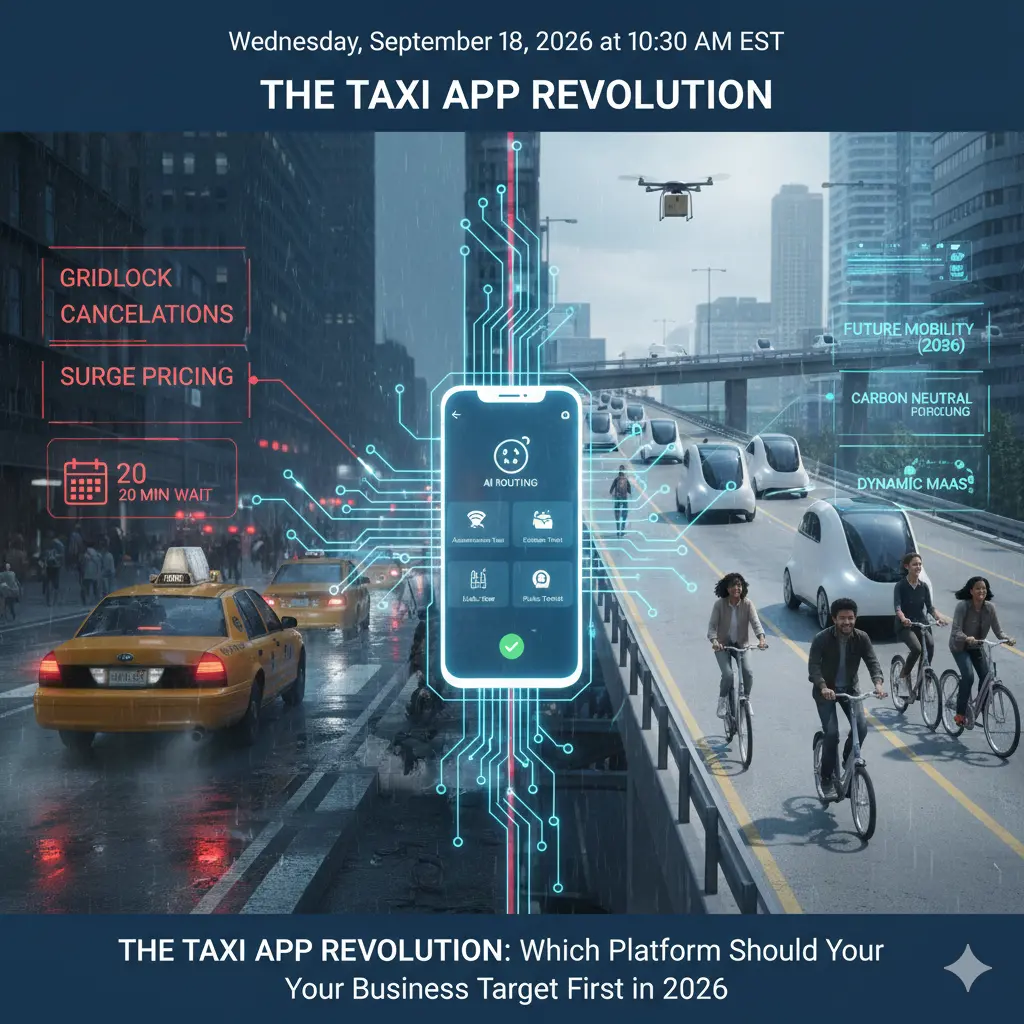
The year 2026 marks the definitive end of the "rideshare" era and the birth of the Autonomous Mobility Ecosystem. We have moved beyond the simple act of hailing a car via a smartphone; we are now in the age of Integrated Mobility-as-a-Service (MaaS). In this new landscape, AI-powered platforms orchestrate a complex dance of electric autonomous vehicles (EAVs), micro-mobility pods, and vertical takeoff and landing (eVTOL) aircraft.
For small and medium-sized enterprises (SMEs)—whether you are a local courier service, a private hire fleet, or a hospitality brand looking to provide seamless guest transport—the choice of which platform to integrate with first is the most critical strategic decision of the decade.
In 2026, the question isn't just "how do we get from A to B?" but "which digital nervous system should our business plug into?"
To choose the right platform, you must first understand the fragmented nature of the 2026 market. Mobility has split into four distinct "utility zones":
The Logistics Super-Apps (Uber & Grab): These platforms have moved beyond people to become the "Operating System for Local Movement."
The Robotaxi Pioneers (Waymo & Tesla Network): These represent the high-efficiency, low-cost autonomous future.
The Multimodal Integrators (Moovit & Citymapper): These platforms prioritize eco-conscious, multi-leg journeys combining public and private transit.
The Vertical Specialist Apps (Holo & SkyPort): These focus on high-net-worth "air-taxi" transit for bypassing ground-level congestion.
Best For: Retailers, high-volume courier services, and corporate travel.
By 2026, Uber has completed its transformation into a logistics engine. Their "Uber Direct" service now powers the delivery backbone for 40% of small businesses in major urban centers.
Why target it first? If your business relies on predictable volume and rapid fulfillment, Uber is the powerhouse. Their 2026 API allows for "Hyper-Local Batching," where a single vehicle (often autonomous) can drop off a passenger and three retail packages in one optimized loop.
The 2026 Advantage: Uber’s Sustainability Scorecard is now a mandatory metric for corporate clients. By integrating with Uber’s EV-only "Green Fleet," your business automatically meets ESG (Environmental, Social, and Governance) compliance standards, making you a more attractive partner for big-ticket contracts.
Best For: Private hire fleets, luxury hospitality, and specialized transport.
In 2026, the cost per mile of autonomous transport has officially dropped below the cost of owning a personal vehicle. Waymo (now operating in 50+ global cities) and the Tesla Network are the leaders in Fleet-as-a-Service.
Why target it first? If your business is looking to eliminate labor costs and human error, these are your primary targets. A local hotel brand, for instance, can now operate a "virtual shuttle" service using Waymo’s API without ever owning a single van or hiring a single driver.
The 2026 Advantage: Their AI-driven "Predictive Positioning" ensures that vehicles are already in high-demand zones before the demand even peaks. For a business, this means zero wait times for your customers, creating a "premium" brand perception at a "budget" operational cost.
Best For: Tourism boards, event organizers, and eco-centric brands.
Moovit (under Intel’s Mobileye) has become the gold standard for Multimodal Integration. In 2026, users don't want five different apps for a bus, a train, a scooter, and a taxi; they want one ticket.
Why target it first? If your business values environmental impact and urban connectivity, Moovit is the gatekeeper. By listing your service (e.g., a local bike-share or a private shuttle) on a MaaS platform, you become part of a "Total Journey" ticket.
The 2026 Advantage: Governments in 2026 are subsidizing "Last-Mile" connections. If your business provides the final leg of a journey starting on public transit, you can tap into municipal tax credits and subsidized fare schemes through these integrators.
Platform | Primary Strength | Best Business Alignment | Key 2026 Tech |
Uber / Grab | Network Density | Retail & Quick Commerce | AI Logistics Batching |
Waymo / Tesla | Low Operational Cost | Hospitality & Fleet Ops | Level 5 Autonomy |
Moovit / Transit | Sustainability & Policy | Public Sector & Tourism | Blockchain Ticketing |
SkyPort / Joby | Speed (Vertical) | High-End VIP Services | eVTOL Infrastructure |
Export to Sheets
If you want to dominate the mobility space this year, your integration strategy must go deeper than just "being on the app."
In 2026, your "shopfront" is an API. Whether you are a restaurant or a pharmacy, your internal software must be able to "call" a taxi or a delivery pod automatically. The faster your system talks to Uber or Waymo, the higher your "Reliability Rank" becomes within their algorithms.
Most platforms in 2026 offer significantly lower commission rates for businesses using or requesting Electric Vehicles. Ensure your fleet or your delivery requirements are flagged as "Zero-Emission" to stay at the top of the search results.
The "Taxi Revolution" has turned the backseat into a digital storefront. In 2026, autonomous vehicles are equipped with interactive screens. Businesses can now target passengers based on their destination. If a Waymo is taking a passenger to a hotel, local restaurants can "suggest" a reservation directly on the vehicle's screen during the ride.
The choice depends entirely on your Customer’s Intent:
If your customers value Speed and Reliability above all: Target Uber. Their density is still their greatest moat.
If your business is built on Cost-Efficiency and Innovation: Target Waymo or Tesla. The autonomous shift is where the greatest margins are found in 2026.
If your brand is defined by Sustainability: Target Moovit. Aligning with public transit ecosystems is the only way to capture the eco-conscious Gen Z and Alpha markets.
In 2026, you don't just "book a ride"—you integrate a lifestyle. Choose the platform that best mirrors the future your customers want to live in.
Would you like me to draft a "Mobility Integration Audit" for your business to see which platform’s API aligns best with your current tech stack?