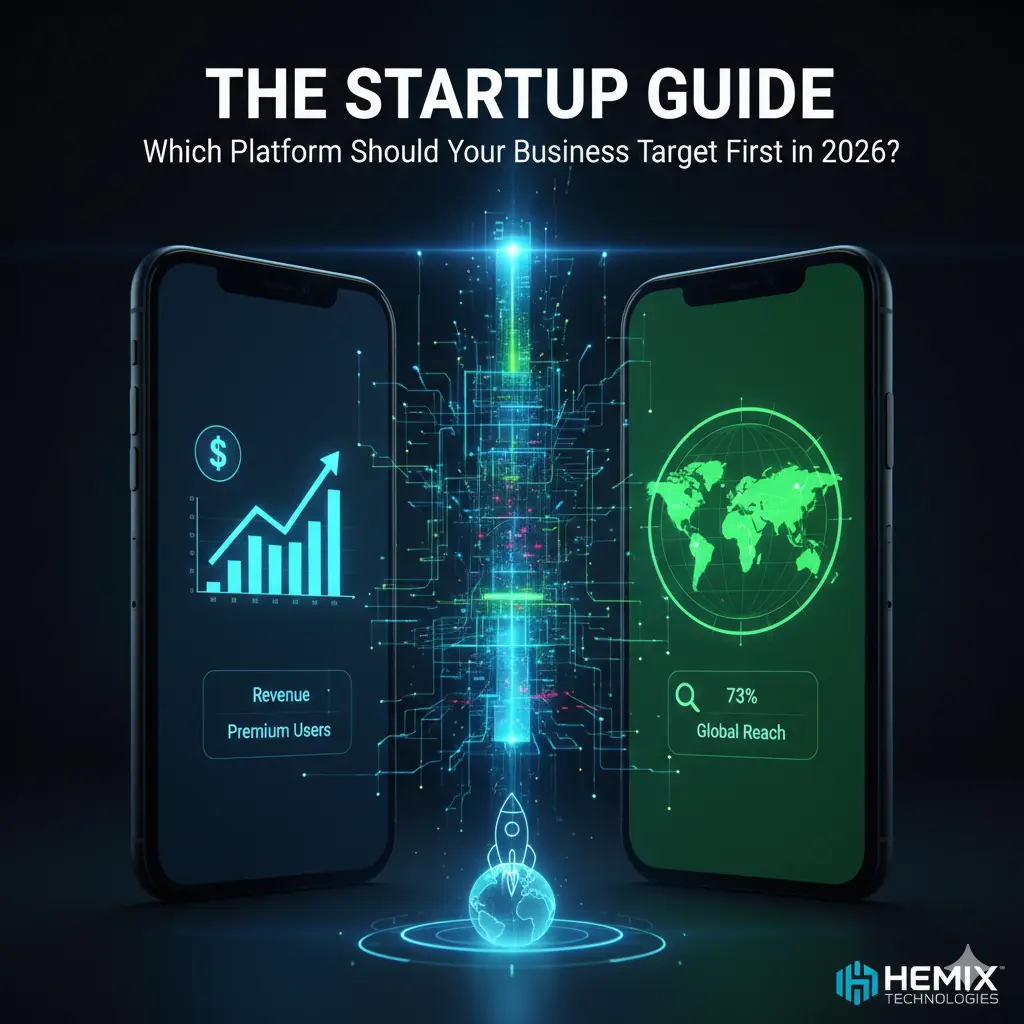
In 2026, the mobile landscape has moved beyond the simple "Apple vs. Google" debate. We are now in the era of Agentic OS, where apps are no longer just tools but active participants in a user's digital ecosystem. For a startup, choosing a platform isn't just about code—it’s about choosing your first neighborhood. Do you want to be in the "premium private club" of iOS or the "massive global stadium" of Android?
With limited seed funding and a burn rate that demands results, you cannot afford to launch everywhere at once. This guide breaks down the 2026 strategic factors to help you decide where to plant your flag.
The most stark divide in 2026 remains the monetization potential. While Android dominates the number of hands holding devices, iOS dominates the number of hands holding credit cards.
iOS (The Profit King): In 2026, the App Store is projected to generate $161 billion in revenue, despite only holding roughly 27% of global market share. iOS users spend an average of $10.40 monthly on apps.
Android (The Reach King): Holding 73% of the world's market share, Android is your go-to for scale. However, average monthly spending is significantly lower at $1.40 per user.
The Startup Strategy:
Choose iOS first if your business model relies on subscriptions, premium SaaS, or high-ticket e-commerce.
Choose Android first if your revenue comes from mobile advertising, high-volume transactions, or data-driven services.
Geography is destiny for many startups. By 2026, the regional split has polarized even further.
Region | iOS Market Share | Android Market Share | Recommended First Target |
North America (USA/Canada) | ~58% | ~41% | iOS |
India | ~4% | ~96% | Android |
Western Europe | ~48% | ~52% | Cross-Platform |
Japan | ~69% | ~31% | iOS |
Southeast Asia / Africa | <15% | >85% | Android |
Export to Sheets
In 2026, AI is the foundation, not a feature. How you want your app to "think" should influence your platform choice.
Apple Intelligence (Privacy & Trust): Apple’s AI agents operate primarily on-device. If your startup handles sensitive data—think HealthTech, FinTech, or private journals—launching on iOS allows you to market "Privacy-First AI."
Google Gemini (Integration & Automation): Google’s AI is more "permissive." It interacts seamlessly across the user's entire digital life (Gmail, Maps, Calendar). If your app is an AI Assistant or a Productivity tool that needs to automate user tasks across different services, Android offers more flexibility.
For a startup, Time-to-Market is the ultimate currency.
iOS Speed: Because Apple controls both hardware and software, testing is streamlined. You only have a few screen sizes and OS versions to worry about. On average, an iOS MVP can launch 31% faster than a native Android one.
Android Complexity: The "fragmentation" of 2026 means your app must work on a $150 budget phone in Mumbai and a $2,000 foldable in New York. This requires more QA (Quality Assurance) testing, which can bloat your initial development timeline by 30-40%.
Different industries have different "gravity" towards platforms:
E-commerce: High-end brands should start with iOS (35% higher average order value). Mass-market marketplaces should start with Android (81% push notification opt-in rates for flash sales).
FinTech: Start with iOS for higher trust and security marketing.
Social & Community: Start with Android to achieve the "network effect" and viral growth faster through sheer volume.
Gaming: If you have high-end graphics or AR/VR features, iOS (ARKit 6) is currently the superior platform for performance.
By 2026, the performance gap between native and cross-platform (Flutter, React Native) has virtually disappeared for 95% of business apps.
Why Cross-Platform is the Startup Favorite in 2026:
40% Cost Savings: You maintain one codebase instead of two.
Unified Brand: Your app looks and feels identical on every device.
Fast Pivots: When user feedback tells you to change a feature, you only have to change it once.
Go Native ONLY if: You are building a high-end game, an app requiring deep hardware sensor access, or a complex AI model that must run at the metal level.
Choosing your platform is your first major business experiment.
Define your MVP goal: Is it Revenue (iOS) or Scale (Android)?
Define your geography: Where does your Target User live?
Choose your stack: If you need to reach both audiences quickly and on a budget, Cross-Platform is your winner.
Ready to start building? At Hemnix, we help startups navigate these exact hurdles. Whether you need a high-performance Flutter app or a native iOS powerhouse, we build for the world of 2026 and beyond.
Would you like me to help you create a specific feature roadmap based on your industry?