By early 2026, the conversation around Decentralized Applications (dApps) has shifted from "proof-of-concept" to "proof-of-impact." We have officially entered the Infrastructure Era, where the underlying blockchain is no longer a bottleneck but a specialized tool.
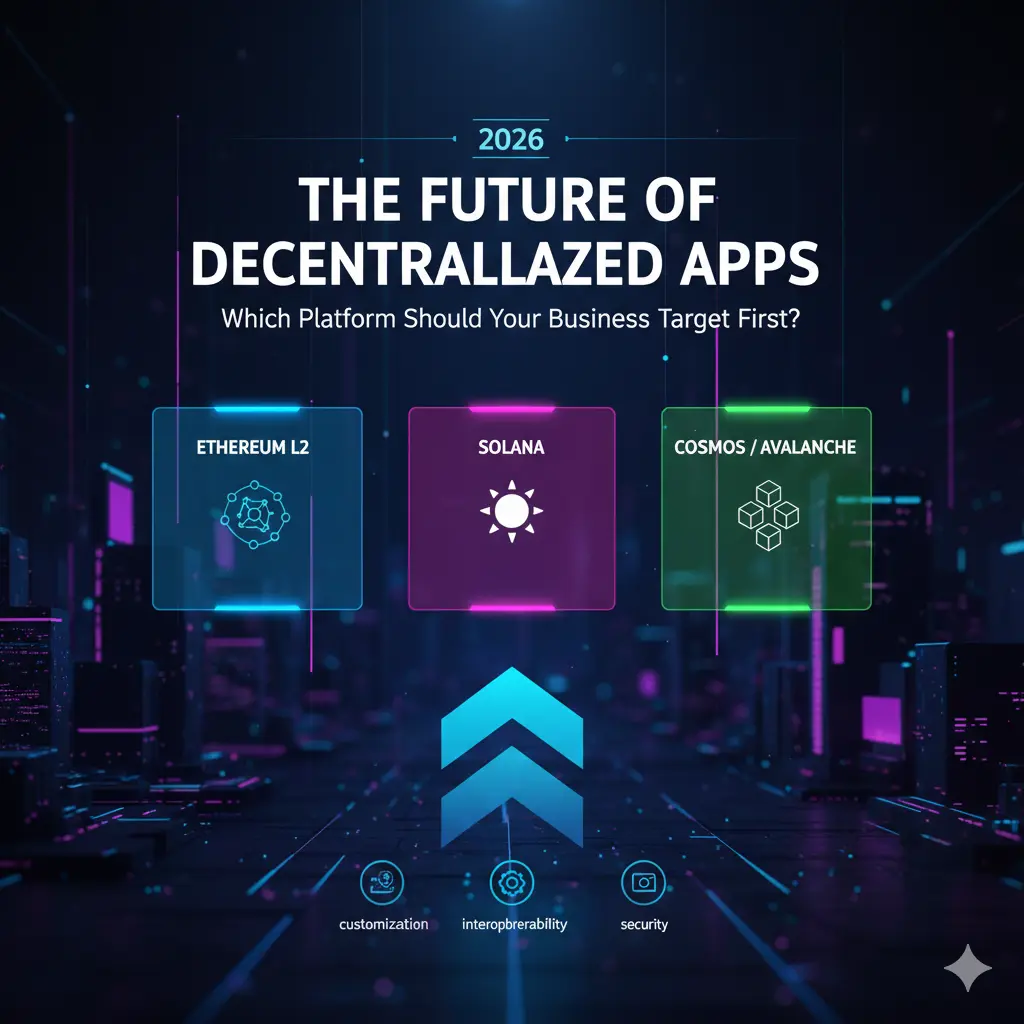
For businesses, the choice of a launch platform is now a high-stakes decision that affects your Tech Sovereignty—your ability to scale without being held hostage by network congestion, soaring gas fees, or centralized gatekeepers. In 2026, the market has bifurcated into clear "neighborhoods": Ethereum for institutional trust, Solana for high-velocity retail, and App-Chains for total corporate control.
Here is how to navigate the 2026 dApp landscape to find your business's first home.
In 2026, the most successful dApps aren't just "apps on a blockchain"—they are modular systems.
Modular (The Ethereum Path): You separate the layers of your application. You might handle execution on a cheap Layer 2 (L2), store your data on a specialized Data Availability layer (like Celestia), and settle everything on Ethereum for maximum security.
Monolithic (The Solana Path): Everything happens on one high-performance layer. It’s faster to build and easier for users, but you rely entirely on that single network’s uptime and performance.
Despite the rise of competitors, Ethereum (specifically through its Layer 2 extensions) remains the primary target for high-value, mission-critical applications. * State of the Network: Following the Fusaka Upgrade in late 2025, Layer 2 transaction costs have plummeted, while throughput across the ecosystem has hit nearly 5,000 transactions per second (TPS).
Best For: DeFi protocols, Real-World Asset (RWA) tokenization, and DAO governance.
Target L2s:
Base: For consumer-facing apps needing the Coinbase user bridge.
Arbitrum/Optimism: For established DeFi and deep liquidity.
zkSync Era: For privacy-sensitive enterprise apps using Zero-Knowledge proofs.
If your business targets the retail market, AI agents, or high-frequency payments, Solana is the undisputed leader in 2026.
State of the Network: The full public release of Firedancer has finally resolved Solana’s historical reliability issues. It now processes over 2 billion transactions per week with sub-second finality.
Best For: Gaming (GameFi), high-frequency trading (DEXs), social dApps, and micropayments.
The 2026 Edge: It is the primary hub for "AI Agents"—automated dApps that trade and interact millions of times daily without human intervention.
For enterprises that cannot risk sharing a network with thousands of other apps, App-Chains are the gold standard.
State of the Network: Cosmos’s Inter-Blockchain Communication (IBC) protocol is now the industry standard for interoperability, allowing separate chains to talk to each other seamlessly.
Best For: Governments (CBDCs), Supply Chain consortia, and private banking.
The Advantage: You can customize your own validator set and even enforce KYC/AML at the protocol level.
Business Objective | Target Platform | Primary Benefit |
Institutional Finance | Ethereum (L2s) | Maximum security and liquidity |
Mass Retail / Gaming | Solana | Lowest fees, highest speed |
Supply Chain / Private | Cosmos / Avalanche | Total control and custom compliance |
Enterprise Integration | Polygon | Massive partnership ecosystem |
Export to Sheets
When building your first dApp, ensure it includes these 2026 "must-haves":
Account Abstraction: Users shouldn't need a seed phrase. They should log in with Biometrics (FaceID) or social accounts, while the business "sponsors" their gas fees to make it feel like a Web2 app.
Cross-Chain Interoperability: Don't lock yourself into one chain. Use protocols like LayerZero or IBC so your dApp can live on Ethereum but allow users to pay with assets from Solana.
AI Integration: 2026 is the year of Intelligent Ops. Your dApp should be able to process "intent"—where a user says "Optimize my yield" and the dApp's AI agents execute the complex smart contract steps automatically.
Privacy-by-Design: With global regulations tightening, using Zero-Knowledge (ZK) technology to prove data is valid without revealing the data itself is a competitive advantage.
Ask yourself these three questions to find your starting line:
If you are building for a bank or a $100M hedge fund, Ethereum L2s are mandatory for their security guarantees. If you are building a social app for Gen Z, Solana’s speed is non-negotiable.
If you must keep your user data or transaction logic hidden from competitors, you should target Avalanche Subnets or an Ethereum ZK-Rollup like Starknet.
If speed-to-market is the goal, building a monolithic app on Solana or a standard EVM app on Polygon is significantly faster than designing a custom modular architecture from scratch.
In 2026, the most successful businesses are Blockchain Agnostic. They start on one platform—usually a high-performance Ethereum L2 like Base or a retail powerhouse like Solana—but they build with modularity in mind. This allows them to pivot their "execution layer" as new, cheaper technologies emerge without having to rebuild their entire logic.
Your First Step: For most businesses, we recommend starting with an Ethereum L2 like Base or Arbitrum. It provides the "institutional blessing" of Ethereum’s security with the modern performance needed to satisfy today's users.
Would you like me to draft a technical comparison of the development environments (Solidity vs. Rust) for your engineering team?