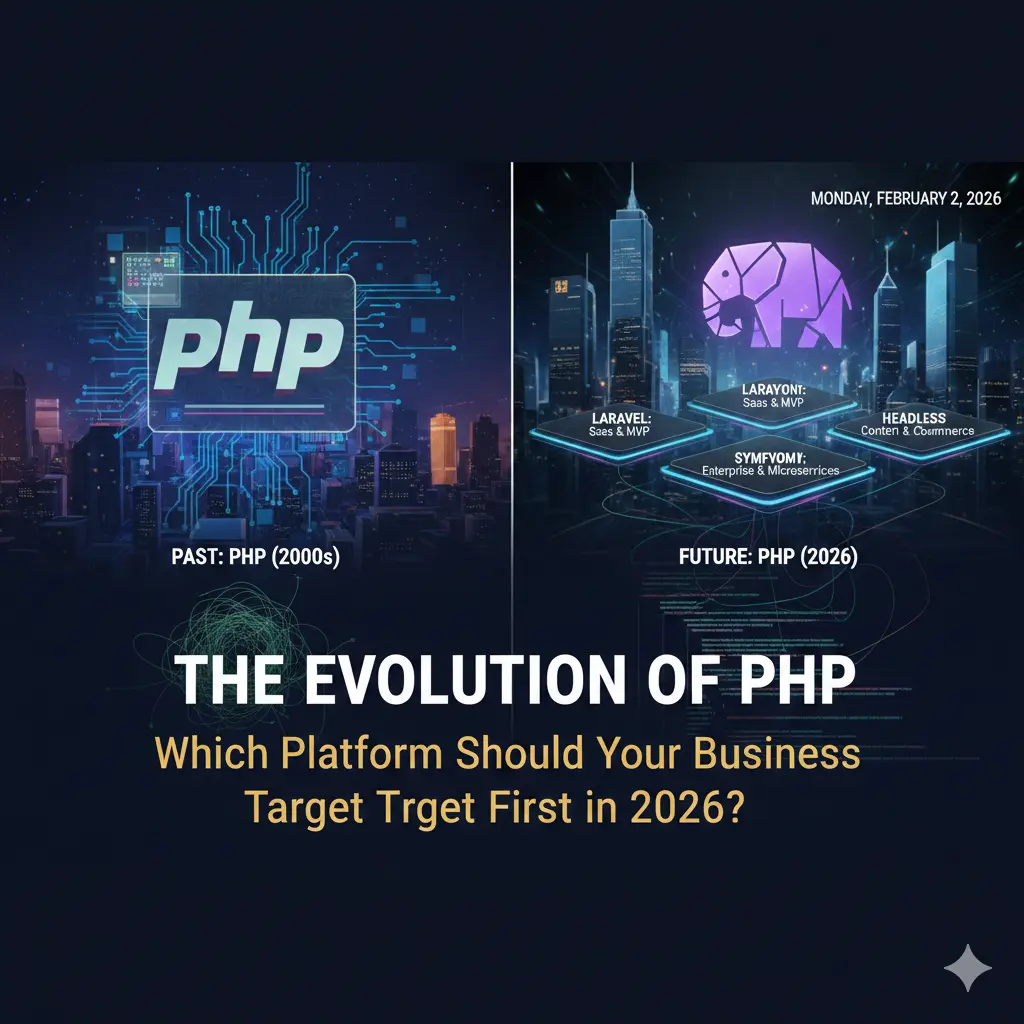
For over a decade, the tech world has echoed with the same recurring prediction: "PHP is dead." Yet, as we move through 2026, the data tells a radically different story. PHP doesn't just exist; it dominates. Powering over 76% of all websites with a known server-side language, PHP has undergone a structural and architectural metamorphosis that has transformed it from a "hobbyist's scripting tool" into a high-performance, enterprise-grade powerhouse.
For business owners and stakeholders, the question in 2026 isn't whether to use PHP, but rather: Which PHP-based platform should your business target first to maximize ROI and scalability?
To understand where to invest, we must first look at how far the language has come. If your perception of PHP is stuck in the era of messy "spaghetti code," it is time to reset your expectations.
Performance Revolution: Since the release of PHP 7 and the subsequent 8.x branch, execution speeds have tripled. The introduction of the Just-In-Time (JIT) compiler and Zend Engine 3 allows PHP to handle high-concurrency requests with efficiency that rivals Node.js and Python.
Type Safety & Predictability: Modern PHP (8.4+) treats types as contracts, not suggestions. With features like Readonly Properties, Enums, and Attributes, the language now enforces the kind of architectural discipline previously reserved for Java or C#.
Asynchronous Capabilities: Projects like Swoole and Laravel Octane have broken the "synchronous-only" barrier, allowing PHP to handle real-time features like WebSockets and live dashboards.
When deciding where to launch your digital product in 2026, you aren't just choosing a language; you are choosing an ecosystem. Here are the three primary PHP "platforms" your business should consider.
If you are a startup or a business looking to launch a Software-as-a-Service (SaaS) product, Laravel is the undisputed first choice in 2026.
Why target it first? Laravel’s "batteries-included" philosophy means features like authentication, payment integration (via Cashier), and queue management are built-in. This reduces "plumbing" time and accelerates your Time-to-Market (TTM).
Business Advantage: The ecosystem (Forge, Vapor, Nova) allows for "zero-downtime" deployment and serverless scaling on AWS, keeping infrastructure costs low while your user base grows.
For large-scale organizations building complex, long-term corporate systems, Symfony is the target platform.
Why target it first? Symfony is highly modular. It is designed for businesses that need Long-Term Support (LTS) and high customization. Many other platforms (including Laravel and Drupal) are actually built on Symfony components.
Business Advantage: It is ideal for Microservices. If your business requires a decoupled architecture where different departments use different services, Symfony’s dependency injection and stability make it the safest bet for 2026 compliance and security.
In 2026, WordPress has evolved beyond simple blogging into a Headless CMS solution.
Why target it first? If your business is content-heavy (Media, E-commerce via WooCommerce, or Educational portals), WordPress provides the most mature administrative interface.
The 2026 Twist: By using WordPress as a "Headless" backend, you can deliver content via a modern React or Vue.js frontend, giving you PHP’s reliability with a cutting-edge user experience.
Feature | PHP (Laravel/Symfony) | Node.js | Python (Django/FastAPI) |
Development Speed | Very High (Proven patterns) | High (Unified JS) | High (Clean syntax) |
Hiring Costs | Competitive/Wide talent pool | High (Niche expertise) | Moderate to High |
Hosting Costs | Low (Ubiquitous support) | Moderate | Moderate |
Best Use Case | Business Apps, SaaS, CMS | Real-time, IoT | AI, Data Science |
In 2026, the availability of developers is a critical risk factor. PHP has one of the largest talent pools globally. Unlike "trendy" languages where developers command astronomical salaries for unproven frameworks, PHP developers are abundant, and their expertise is battle-tested. This ensures that your project won't stall because you can't find a specialized engineer.
Modern PHP is "Docker-first." Whether you are deploying on Kubernetes, Google Cloud Run, or AWS Lambda, PHP 8.x containers are lightweight and highly portable. This "operational simplicity" translates directly to lower DevOps overhead and reduced monthly cloud bills.
The sheer volume of legacy and modern PHP code online makes it the best-supported language for AI coding assistants like GitHub Copilot. In 2026, this means your team can generate boilerplate code and fix bugs faster in PHP than in newer languages that lack a 25-year-old training data set.
The "Evolution of PHP" has reached a peak where it is no longer a compromise—it is a strategic advantage.
If you are building an MVP or a SaaS: Target Laravel. The speed of delivery will allow you to pivot based on user feedback before your competitors even finish their setup.
If you are building a Global Enterprise Tool: Target Symfony. The stability and modularity will protect your investment for the next decade.
If you are building a Content/E-commerce Brand: Target Headless WordPress. You gain the world's best content tools without sacrificing frontend performance.
In 2026, the most successful businesses aren't the ones using the "coolest" tech; they are the ones using the most reliable tech to solve real problems. PHP is that bridge.
Would you like me to create a technical roadmap for migrating your current legacy system to a modern PHP 8.4 framework?
This video offers a deep dive into the practical state of PHP as we move toward 2026, specifically focusing on its continued relevance in modern web architecture.