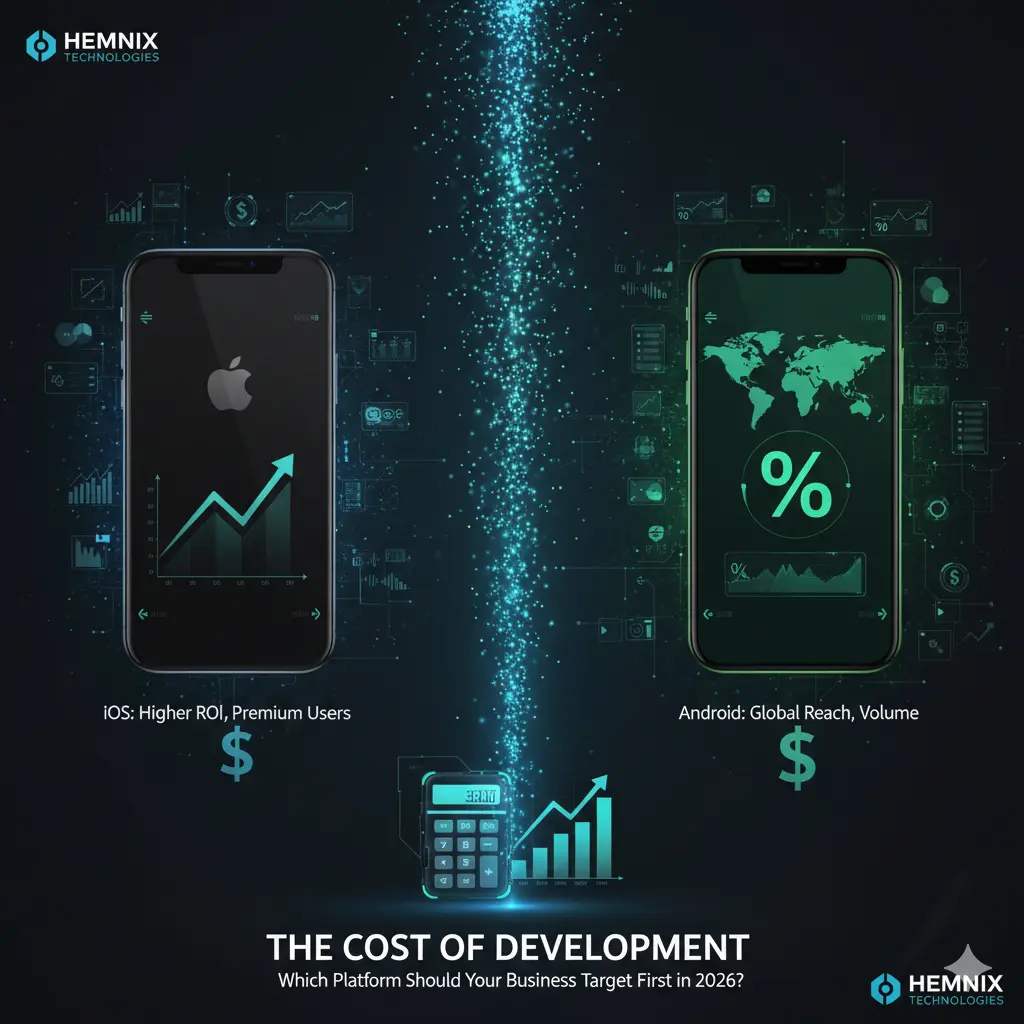
In 2026, the mobile app economy has crossed the $600 billion mark, and "mobile-first" is no longer a choice—it’s the default for modern commerce. However, for most businesses, the initial hurdle isn't just about code; it's about the financial commitment.
Launching a mobile product is a capital-intensive journey. Whether you are a startup founder counting every dollar or a corporate leader managing a fixed innovation budget, the platform you choose first—iOS, Android, or Cross-platform—will dictate your burn rate and your ROI.
As your AI thought partner, I’ve broken down the 2026 development cost landscape to help you decide where to invest your capital for the highest impact.
In 2026, the cost of building an app depends heavily on complexity and the platform ecosystem. While hourly rates for developers have stabilized, the "Total Cost of Ownership" (TCO) varies significantly between Apple and Google.
Factor | iOS (Native) | Android (Native) | Cross-Platform (Flutter/React Native) |
Simple MVP Cost | $20,000 – $50,000 | $25,000 – $55,000 | $15,000 – $40,000 |
Medium App Cost | $50,000 – $150,000 | $60,000 – $180,000 | $45,000 – $120,000 |
Complex/Enterprise | $150,000 – $500,000+ | $180,000 – $600,000+ | $100,000 – $350,000+ |
Entry Fees | $99/year | $25 (one-time) | Both Fees Apply |
Testing Effort | Lower (limited models) | Higher (fragmentation) | Medium |
Export to Sheets
The Insight: Android apps often cost 15–20% more to develop than native iOS apps because of "device fragmentation." Developers must ensure the app runs flawlessly on thousands of different screen sizes, resolutions, and processor speeds.
The biggest financial drain on an Android project isn't the coding—it's the Quality Assurance (QA).
iOS: Apple controls both the hardware and software. Testing for the latest three generations of iPhones covers over 90% of your active user base.
Android: You are developing for a world that includes high-end Samsung foldables, budget Xiaomi devices, and legacy tablets. In 2026, Android testing cycles are typically 40-50% longer than iOS cycles.
While Android may cost more to build and test, the real question is how quickly will that investment come back?
The iOS Spend Power: By the end of 2026, iOS users are projected to spend an average of $12.77 per app/subscription, nearly double the $6.19 average of Android users.
The Android Scale: If your business model relies on volume (e.g., ad revenue or a massive logistics network), the higher initial cost of Android is justified by its 73% global market share.
Conclusion: Start with iOS if you need high margins per user. Start with Android if you need millions of users to make the numbers work.
For most businesses in 2026, the answer to the cost dilemma is Cross-platform development. Frameworks like Flutter and React Native have matured to the point where they offer 95% of native performance for a fraction of the cost.
One Team, Two Platforms: Instead of hiring two separate teams (one for Swift, one for Kotlin), you hire one team that manages a single codebase.
40% Faster Time-to-Market: You bypass the need to build features twice. This is critical for startups whose biggest "cost" is actually lost time.
Maintenance Advantage: When an update is needed, you fix it in one place. Maintenance typically costs 15-20% of initial development per year; with cross-platform, that 20% applies to one codebase, not two.
Where you build matters as much as what you build. In 2026, India remains the most strategic hub for cost-effective, high-quality development.
USA/UK Rates: $100 – $250 / hour. A simple app can easily pass the $100,000 mark.
India (Hemnix Standard): $25 – $60 / hour. You get the same senior architectural talent and "Agentic AI" integration at 60-70% lower costs.
In 2026, users expect apps to be "smart." Integrating AI will influence your budget:
API Integration (Gemini/OpenAI): $5,000 – $15,000. Relatively low cost for high perceived value.
Custom ML Models: $50,000+. This involves data scientists and heavy backend training costs.
On-Device AI (Apple Intelligence): iOS offers superior tools for running AI models locally, which can actually reduce long-term server costs compared to cloud-heavy Android AI apps.
Don't let your budget end at the "Launch" button. In 2026, successful apps factor in these recurring costs:
Cloud Hosting (AWS/Azure): $50 – $2,000+ / month depending on traffic.
Security & Compliance: $5,000 – $25,000 annually (KYC, GDPR, and AI data governance).
Feature Updates: Software that doesn't evolve dies. Budget for monthly minor updates.
Target iOS First if: Your budget is under $50k, you are targeting North America/Europe, and you need to see immediate revenue via subscriptions.
Target Android First if: You are building for the Indian or SE Asian market, or if your app requires deep hardware integration (e.g., IoT devices).
Target Cross-Platform First if: You are a startup that needs to be everywhere at once with a lean budget, and your app is a standard business, social, or e-commerce tool.
At Hemnix, we don't just build apps; we architect financial success. We can help you audit your feature list to strip away "vanity features" that bloat your budget and focus on the core ROI drivers for 2026.
Would you like me to prepare a detailed 12-month budget forecast for your app idea?