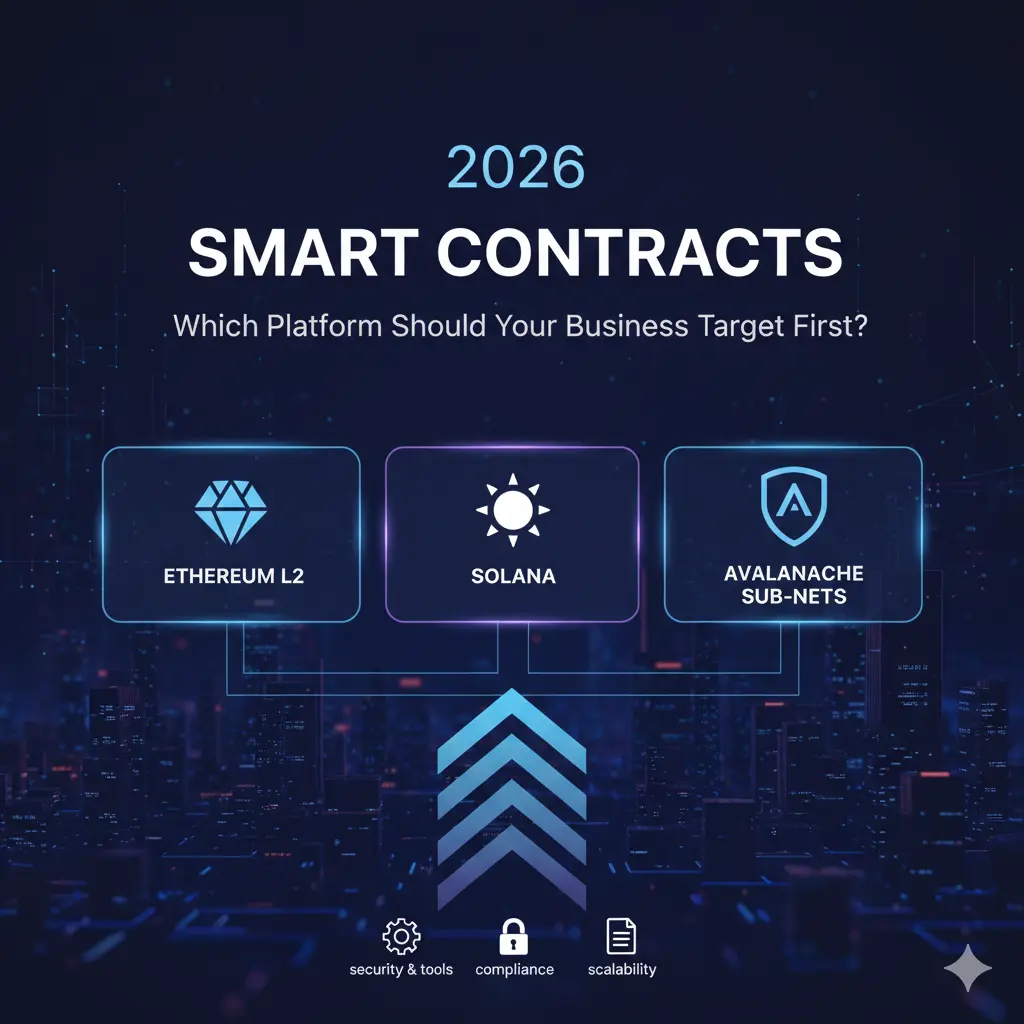
The year is 2026, and smart contracts are no longer a niche technology; they are the bedrock of digital trust and automation for businesses across every sector. From supply chain management to automated legal agreements and decentralized finance, smart contracts offer unparalleled efficiency, transparency, and immutability.
However, the proliferation of blockchain platforms means that choosing the right one for your business's first smart contract deployment can be a daunting, yet critical, decision. The platform you select will dictate your development costs, transaction speeds, security guarantees, scalability, and access to developer talent and user liquidity.
This guide will break down the leading smart contract platforms in 2026, helping your business make an informed decision on where to begin its journey into this transformative technology.
Before diving into specific platforms, let's establish the key factors that define a robust smart contract environment in 2026:
Security & Immutability: The paramount concern. Your chosen platform must offer proven cryptographic security and guarantee that once a contract is deployed, its logic cannot be altered without consensus.
Scalability & Throughput: Can the platform handle the volume of transactions your business requires without prohibitive fees or slowdowns? This is often the biggest bottleneck.
Cost-Effectiveness (Gas Fees): High transaction costs (gas fees) can quickly erode the economic benefits of smart contracts.
Developer Ecosystem & Tools: A vibrant developer community, comprehensive SDKs, robust documentation, and easy-to-use development tools are crucial for efficient deployment and maintenance.
Interoperability: Can your smart contracts communicate with other blockchains or traditional systems? Isolated platforms have limited utility.
Regulatory Compliance Support: With evolving global regulations, platforms that offer features like verifiable identities or privacy-preserving transactions are gaining importance for enterprise use.
Decentralization: The degree of decentralization impacts censorship resistance and single points of failure.
These two platforms represent distinct philosophies in smart contract execution and remain the frontrunners in 2026.
Still the reigning champion for high-value and mission-critical smart contracts. Ethereum's robust security, battle-tested network, and massive developer community make it the go-to for many enterprise applications.
Pros:
Unmatched Security: The largest and most decentralized smart contract platform, making it incredibly secure and censorship-resistant.
Deepest Liquidity & DeFi: Powers the vast majority of decentralized finance (DeFi) and tokenized real-world assets (RWAs).
Mature Tooling & Ecosystem: Extensive development tools, libraries, and a huge talent pool proficient in Solidity.
Modular Scalability (Layer 2s): While Ethereum Layer 1 (L1) can be costly, its Layer 2 (L2) ecosystem (Arbitrum, Optimism, zkSync, Starknet, Base) offers scalable and cost-effective execution while inheriting L1 security.
Cons:
L1 Costs: Direct deployment on Ethereum L1 is expensive for frequent transactions.
Complexity of L2 Choice: Navigating the various L2s requires understanding their trade-offs.
Best For: Tokenized securities, complex financial instruments, supply chain provenance for high-value goods, automated legal contracts, and enterprise blockchain solutions where security and trust are paramount. Think of integrating with existing financial infrastructure or managing critical digital assets.
Solana has solidified its position as the preferred platform for high-throughput, low-latency smart contracts, particularly suited for consumer-facing applications, gaming, and real-time data processing.
Pros:
Blazing Fast & Low Cost: Achieves thousands of transactions per second (TPS) with near-zero transaction fees, making it ideal for microtransactions and high-volume interactions.
Simplified User Experience: Designed for mass adoption, often allowing for seamless user experiences without constant gas fee considerations.
Growing Developer Ecosystem: A rapidly expanding community using Rust for smart contract development, attracting talent focused on performance.
Cons:
Centralization Concerns: While improving, it is less decentralized than Ethereum, which can be a concern for some enterprise use cases.
Network Stability (Historically): Though significantly improved by 2026 with upgrades like Firedancer, past outages sometimes raise concerns for mission-critical systems.
Best For: Gaming economies, social media platforms, real-time betting, high-frequency trading, ticketing systems, and any application requiring instant, low-cost interactions at scale. If your business prioritizes user experience and transaction volume, Solana is a strong contender.
Beyond the giants, several platforms cater to specific business needs.
Avalanche's "Subnet" architecture allows businesses to launch custom, application-specific blockchains that are fully customizable regarding gas tokens, validators, and even regulatory compliance features.
Pros: Tailored environments, high performance within subnets, EVM compatibility (making it easier for Ethereum developers).
Cons: Requires more technical overhead to set up and manage a subnet.
Best For: Financial institutions needing private or permissioned blockchain environments, consortia requiring shared but controlled ledgers, or businesses wanting full control over their blockchain's parameters.
Polygon continues to be a leader in enterprise adoption due to its suite of scaling solutions (PoS, zkEVM, Supernets). It offers Ethereum compatibility with significantly lower costs and higher speeds.
Pros: Strong enterprise partnerships (Starbucks, Nike), EVM compatibility, and a clear roadmap for scalable, modular solutions.
Cons: Its PoS chain is less decentralized than Ethereum L1, though its zk-rollup solutions are gaining prominence.
Best For: Businesses looking for an easy on-ramp from traditional systems to blockchain, large-scale consumer applications, and enterprises seeking to leverage Ethereum's security without its L1 costs.
These newer Layer 1s, developed by former Meta employees, leverage the Move programming language, which is designed for safe and efficient asset management.
Pros: Enhanced security features for asset manipulation, strong object-oriented model, high transaction throughput.
Cons: Newer ecosystems, smaller developer communities compared to Ethereum or Solana.
Best For: Niche applications requiring extreme asset security, complex digital ownership models, or those willing to invest in a growing, high-performance ecosystem.
To guide your decision, consider these questions:
What is the core function of your smart contract?
High-Value, Trust-Critical (e.g., tokenizing real estate, legal agreements): Ethereum (via L2).
High-Frequency, Low-Value (e.g., in-game items, loyalty points): Solana.
Custom, Regulated Environment: Avalanche Subnets.
Enterprise Adoption with Ethereum Compatibility: Polygon.
What is your budget for transaction fees and development?
Willing to invest in security and mature ecosystem, leveraging L2s for cost savings: Ethereum.
Prioritize ultra-low fees and high volume: Solana.
What kind of developer talent do you have or plan to hire?
Solidity/EVM-compatible (Python, JavaScript): Ethereum, Polygon, Avalanche.
Rust: Solana.
Move: Sui, Aptos.
What level of decentralization and immutability do you require?
Absolute highest: Ethereum.
Very high, balancing performance: Solana.
Customizable for permissioned control: Avalanche Subnets.
In 2026, the smart contract landscape is mature enough to offer specialized solutions for almost every business need. There’s no single "best" platform; only the best platform for your specific use case.
For many businesses, a hybrid approach is becoming the norm. You might deploy a core smart contract on an Ethereum L2 for its security and interoperability with DeFi, while using Solana for a high-volume consumer-facing element that interacts with that core.
Your First Step: For most businesses entering the smart contract space in 2026, targeting an Ethereum Layer 2 (like Arbitrum or Optimism) provides the optimal balance of security, developer tools, access to liquidity, and manageable costs. It's a robust starting point that allows for future expansion and interoperability across the wider blockchain ecosystem.
Ready to explore a specific platform for your smart contract needs?