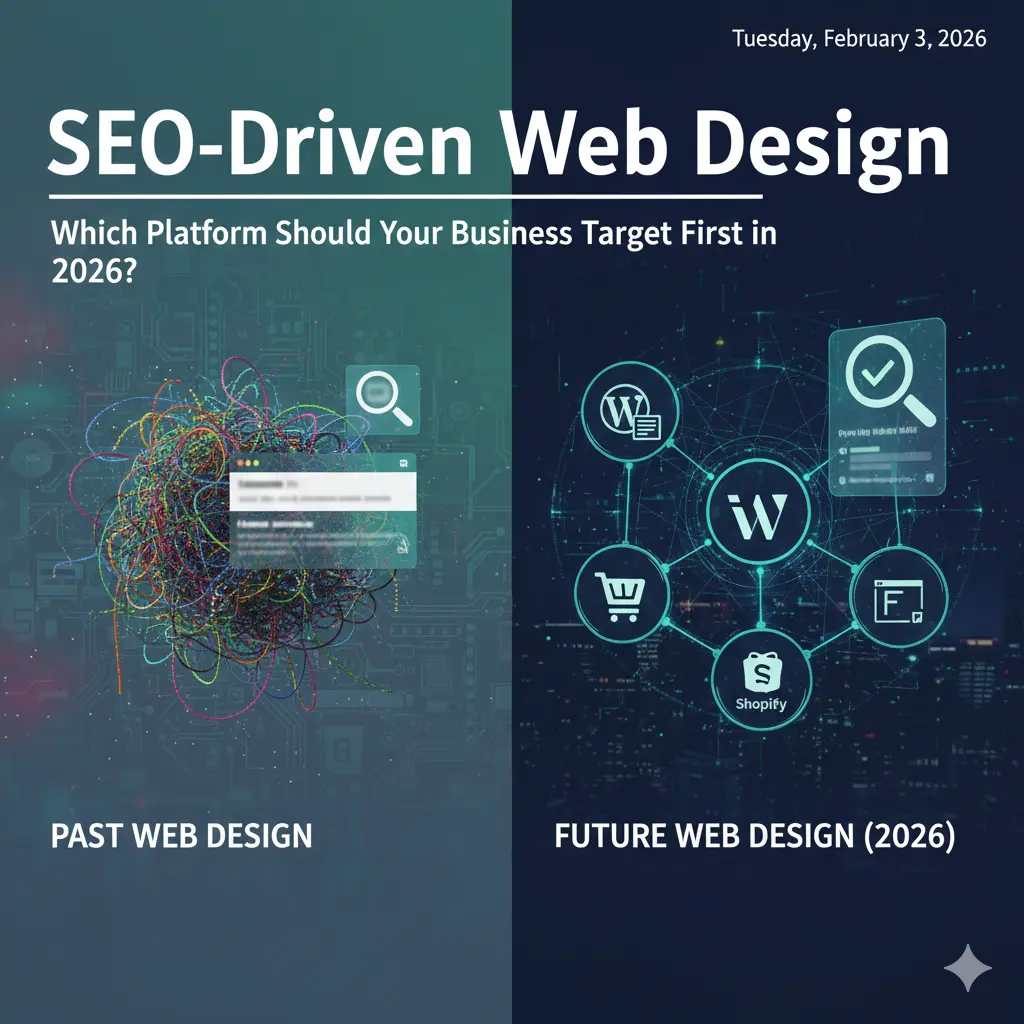
The digital landscape of 2026 has moved beyond the "pretty website" era. Today, web design is no longer just an aesthetic choice; it is a search engine optimization (SEO) strategy in itself. With Google’s algorithms now prioritizing Core Web Vitals 3.0, AI-driven intent interpretation, and Accessibility (WCAG) compliance, the platform you choose acts as the structural foundation for your entire organic growth.
If your platform choice creates "code bloat," slow server response times, or rigid URL structures, even the best content in the world won't rank. In 2026, the question isn't "Can I build a site here?" but "Will this platform's architecture help or hinder my visibility?"
Despite being decades old, WordPress remains the top choice in 2026 for businesses that view content as their primary lead-generation tool. The evolution of the Gutenberg block editor and the shift toward Full Site Editing (FSE) have stripped away much of the "plugin bloat" that used to plague the platform.
SEO Advantage: Unmatched granular control. You can fine-tune every technical detail—from schema markup and canonical tags to "Headless" configurations.
Best For: Blogs, news sites, service-based businesses, and companies requiring complex, custom SEO setups.
The 2026 Reality: To win on WordPress this year, you must avoid heavy "legacy" page builders. Target block-based themes (like GeneratePress or Kadence) to ensure your site passes the 2026 speed benchmarks.
Webflow has become the gold standard for mid-sized businesses and tech startups that refuse to compromise between high-end design and technical SEO. In 2026, its clean code output is its biggest competitive edge. Unlike builders that "wrap" elements in endless layers of code, Webflow writes semantic HTML that search engine crawlers can read with lightning speed.
SEO Advantage: Speed and "Cleanliness." Webflow sites are inherently fast because they lack the database-heavy overhead of traditional CMS platforms.
Best For: Tech startups, creative agencies, and B2B brands that need high-impact animations (Micro-interactions) without sacrificing Core Web Vitals.
The 2026 Reality: While excellent for design, Webflow has "CMS item limits" on lower tiers. If you plan to publish 10,000+ blog posts, the costs may scale faster than WordPress.
In 2026, Shopify is no longer just a "store builder." With the maturation of its Hydrogen (Headless) framework, it allows businesses to build ultra-fast, React-based frontends while using Shopify’s powerful backend.
SEO Advantage: Structured Data. Shopify handles product schema, reviews, and availability tags more natively than almost any other platform, ensuring your products appear in "Google Shopping" and "Rich Snippets" instantly.
Best For: Any business where the primary goal is selling physical or digital products.
The 2026 Reality: Shopify still has a "rigid" URL structure (e.g., /products/ and /collections/). While this is a minor SEO hurdle, the platform’s security and uptime (99.99%) usually outweigh the desire for custom URL slugs.
Framer has exploded in popularity in 2026 for its "Figma-to-Site" workflow. It is arguably the fastest way to get a professional, SEO-ready marketing site live.
SEO Advantage: Built-in performance optimization. Framer automatically handles image compression, lazy loading, and script minification.
Best For: Small businesses, landing pages, and marketing campaigns that need to go live today with a 100/100 PageSpeed score.
The 2026 Reality: It lacks a "deep" CMS. If your SEO strategy relies on thousands of interconnected data points, stick to WordPress or Webflow.
Platform | Code Quality | Speed (Out of Box) | Technical SEO Control | Learning Curve |
WordPress | Variable (Theme dependent) | Moderate | Highest | Moderate |
Webflow | Excellent | High | High | High |
Shopify | Good | High | Moderate | Low |
Framer | Excellent | Highest | Moderate | Low |
Export to Sheets
Regardless of the platform you choose, your 2026 web design must incorporate these three pillars to rank:
Google now measures "Interaction to Next Paint" (INP) as a primary metric. This means your site shouldn't just load fast; it must react fast. Avoid platforms that rely on heavy JavaScript libraries.
Accessibility is now a direct ranking signal. Ensure your platform supports:
Semantic HTML5 tags.
Native ARIA label support.
Adaptive contrast ratios that change based on user device settings (Dark Mode support).
With "AI Overviews" (formerly SGE) dominating search results, your design must be structured so AI agents can parse it. This means using Table of Contents, FAQ Schema, and clear Visual Hierarchies that "feed" AI the answers it is looking for.
Target WordPress first if: You are a content-heavy brand or a service business that needs 100% ownership and a "forever" site that scales with custom plugins.
Target Webflow first if: You are a design-led brand that wants a "custom-coded" feel without the $50k developer price tag.
Target Shopify first if: You have a product to sell. Period. Don't try to "hack" e-commerce into a platform not built for it.
Target Framer first if: You are a small business or startup that needs a "stunning" 5-page marketing site that ranks well on local search immediately.
The best platform is the one that aligns with your Digital DNA. In 2026, a site that isn't built for SEO is simply an expensive business card that no one can find.
Would you like me to analyze your current business goals and provide a custom "Migration Blueprint" for the platform that best fits your needs?