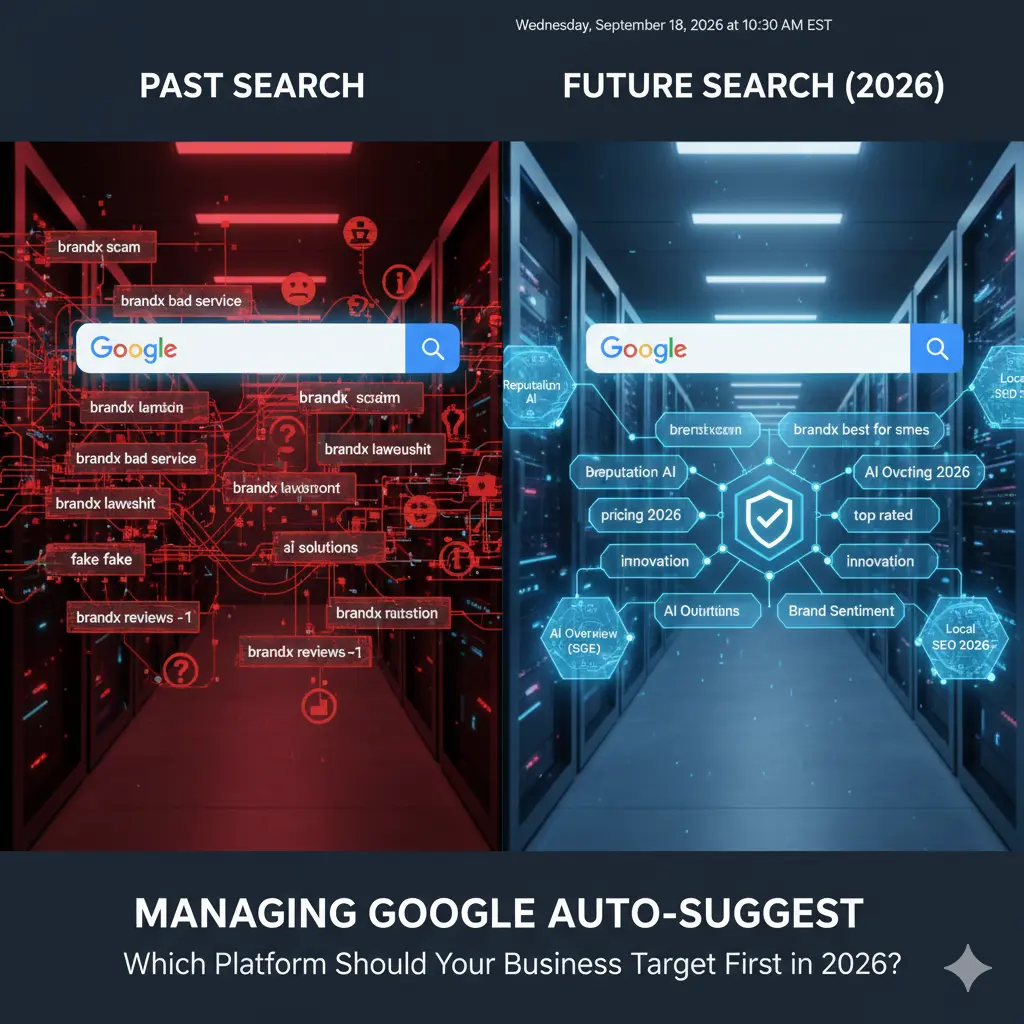

In 2026, your brand’s first impression isn’t your homepage—it’s the Google Search box. Before a user even clicks "Enter," Google’s Autocomplete algorithm has already suggested a narrative for your business. It is estimated that nearly 71% of search queries are influenced by these predictions, making "Search Box Optimization" (SBO) a high-stakes battleground for reputation and revenue.
Negative suggestions like "Scam," "Lawsuit," or "Bad Reviews" can sabotage a sales funnel before it begins. Conversely, positive strings like "Best for SMEs" or "Pricing 2026" act as a powerful third-party endorsement.
As we navigate the "Agentic Web" where AI assistants shop for humans, controlling these predictive paths is critical. But which platform should you target first to reclaim your search narrative?
In 2026, Google’s Autocomplete is heavily fueled by Sentiment Analysis. If the web is buzzing with negative reviews, Google will reflect that in the search box.
Birdeye has evolved into an AI-powered enterprise-grade reputation engine that multi-location brands should target first.
Why target it first? It doesn't just "monitor" reviews; it uses Intelligent Agents to automate engagement across 200+ sites. This creates a high volume of positive, fresh data that can "push out" negative autocomplete suggestions.
The 2026 Advantage: Birdeye’s integration with tools like Jobber and Salesforce allows for Automated Review Requests at the exact moment of customer delight, ensuring your "Sentiment Score" remains high enough to influence Google’s logic.
A new threat has emerged in 2026: AI Answer Engines. Google’s Autocomplete is no longer just reflecting past human searches; it is increasingly influenced by what AI models (Gemini, ChatGPT) say about your brand.
LLMrefs is the first platform designed to track your brand’s Answer Inclusion Rate (AIR)—a metric that is replacing traditional "Rankings" in 2026.
Why target it first? It tracks how AI models cite your brand. If an AI model frequently associates your brand with a specific "solution," that association will eventually leak into Google’s search predictions.
The 2026 Advantage: It identifies the exact URLs and Reddit threads that AI models use to build their "truth." By optimizing these sources, you indirectly "sanitize" the data feeding Google’s predictive engine.
For regional businesses, Google Autocomplete is hyper-local. A user in Shimla will see different suggestions for "Best Accountant" than a user in Delhi.
BrightLocal is the essential target for SMBs focusing on Geographic Search Box Optimization.
Why target it first? It tracks "near me" search trends and local citations. By ensuring your NAP (Name, Address, Phone) data is consistent across the local web, you build the Entity Strength Google needs to suggest your brand to local searchers.
The 2026 Advantage: Its "Audit and Reporting" tools allow you to see exactly which local keywords are triggering your brand name in the suggest box, giving you a roadmap for local content creation.
Platform | Best For | Primary Strength | 2026 KPI to Watch |
Birdeye | Multi-location Brands | Review-driven sentiment | Sentiment Velocity |
LLMrefs | Tech & B2B Brands | AI/LLM Visibility | Answer Inclusion Rate (AIR) |
BrightLocal | Local Service Biz | Geo-targeted citations | Local Suggest Trigger Rate |
SocialPilot | Small Biz / Solopreneurs | GBP Analytics | Branded Search Growth |
Export to Sheets
If you want to move the needle on what Google suggests about your brand, follow this protocol:
Google suggests terms that people are actually searching for. Encourage your audience to search for "Brand + Specific Service" through your marketing campaigns. When thousands of people search for "Birdeye 2026 Reviews," Google begins to offer that as a default suggestion to others.
Optimize for AI Overviews (SGE). Use structured data (Schema.org) to make your content machine-readable. In 2026, the more "Answer-Ready" your site is, the more likely Google will consider your brand an authoritative entity worthy of a suggestion.
Don't just "report" bad suggestions. Instead, create high-authority content (e.g., a "Truth About [Brand] Scam" page) that addresses the query head-on with facts. This "Search Box Optimization" (SBO) strategy flips a negative search into a positive educational opportunity.
The choice depends on the nature of your "suggest" problem:
If you have a "Scam/Bad Review" problem: Target Birdeye to flood the zone with positive sentiment.
If you are invisible in search: Target LLMrefs to win the "Citation War" in AI models.
If you are a local hero: Target BrightLocal to own your neighborhood's predictive path.
In 2026, you don't just wait for people to find you—you guide them to you from the very first keystroke.
Would you like me to draft an "Autocomplete Audit" for your brand to see what users are currently seeing when they type your name?