As we move further into 2026, the mobile landscape has evolved far beyond the simple "Apple vs. Google" debates of the past decade. With the integration of AI-driven operating systems, the rise of foldable devices, and the shifting economic landscapes of global markets, the decision of whether to launch your business’s mobile app on iOS or Android first is more critical than ever.
For startup and enterprises alike, the "cross-platform vs. native" debate is often overshadowed by a more fundamental question: Where is your audience, and how do they spend?
In this comprehensive guide, we’ll break down the current state of the mobile ecosystem in 2026 and help you decide which platform should be your priority.
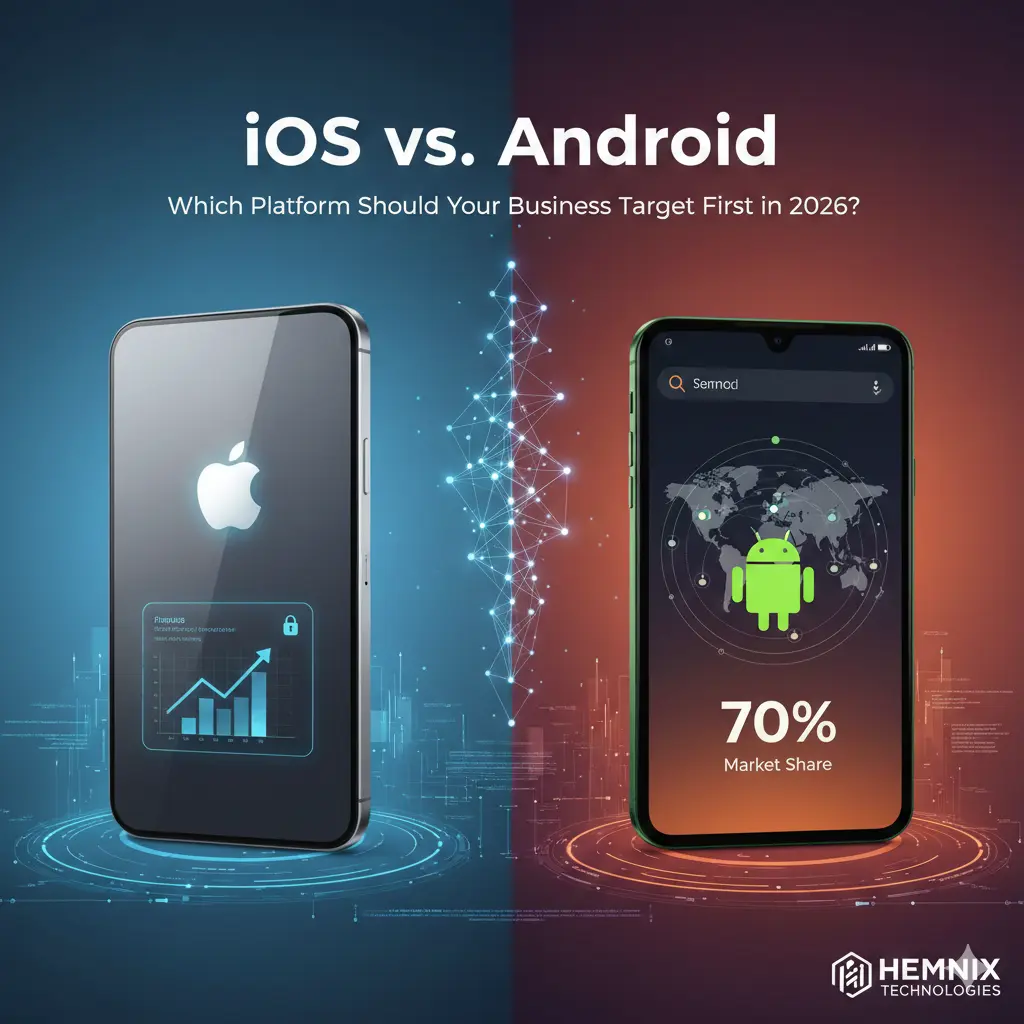
In 2026, the numbers tell a familiar but nuanced story. Android remains the undisputed leader in terms of global market share, holding approximately 70-72% of the world’s smartphone users. If your business goal is maximum reach—specifically in emerging markets like India, Southeast Asia, Latin America, and Africa—Android is the gateway.
However, iOS continues to dominate the "premium" market. In regions like North America, the UK, and parts of Western Europe, iOS market share often hovers near or above 50%.
The Verdict: * Target Android first if you are building a mass-market utility, a social media platform for emerging markets, or a service-based app (like a taxi or delivery service) in Asia or Africa.
Target iOS first if your primary audience is located in the US or Western Europe and belongs to a higher-income demographic.
While Android has the users, iOS has the "spenders." Historically, and continuing into 2026, iOS users have shown a higher willingness to pay for apps, subscribe to services, and engage in in-app purchases.
iOS Monetization: Apple’s ecosystem is designed for seamless spending. With the maturity of Apple Pay and the high lifetime value (LTV) of iPhone users, iOS remains the most profitable platform for "freemium" games, productivity tools, and high-end lifestyle apps.
Android Monetization: While the gap is closing, Android monetization often relies more heavily on ad-supported models. If your revenue strategy is based on mobile advertising rather than direct sales, Android’s massive volume makes it a powerhouse.
In years past, Android development was notoriously slower due to "fragmentation"—the need to test on thousands of different devices and screen sizes. By 2026, development frameworks like Flutter and React Native have matured significantly, but native differences still exist.
iOS Development: Generally considered faster because there are fewer device models to support. Swift (Apple’s programming language) is highly efficient, and the standardized hardware makes UI/UX testing more predictable.
Android Development: While Jetpack Compose has streamlined Android UI development, you still have to account for a vast array of hardware specifications—from budget devices with 2GB of RAM to high-end foldables. This can lead to longer QA (Quality Assurance) cycles.
2026 is the year of the "Agentic OS." Both Apple and Google have integrated deep AI agents into their cores.
The Android Advantage: Google’s integration with Gemini allows Android apps to leverage predictive user intent more fluidly. If your app relies heavily on Google’s suite (Maps, Gmail, Calendar), the Android ecosystem offers a more "open" playground for AI integration.
The iOS Advantage: Apple’s "Apple Intelligence" focuses heavily on privacy-first, on-device AI. If your business handles sensitive user data (FinTech or HealthTech), the marketing advantage of Apple’s privacy-centric AI can be a significant draw for users.
The "gatekeeper" effect is real.
Google Play Store: Generally has a faster and less stringent approval process. It is easier to launch an MVP (Minimum Viable Product) and push frequent updates to gather user feedback quickly.
Apple App Store: Known for its rigorous review process. Apple’s reviewers check for design quality, privacy compliance, and functional stability. While this makes the launch harder, it also acts as a badge of quality for your brand.
E-commerce & Retail: If you are selling luxury goods, start with iOS. If you are a general marketplace, go Cross-platform or Android first to capture volume.
FinTech: Start with iOS due to the higher trust factor and higher concentration of users with investment capital.
Gaming: If it's a high-fidelity game, iOS users are more likely to have the hardware to run it and the money to spend on IAPs. For casual, ad-supported games, Android is king.
Enterprise/B2B: iOS is often preferred as many corporations issue iPhones as standard work devices due to security protocols.
By 2026, the question "Which one first?" is increasingly being answered with "Both, but via one codebase."
Technologies like Flutter and React Native have reached a point where a single team can develop for both platforms simultaneously without sacrificing much in the way of performance. For many startups in 2026, building a cross-platform app is the most cost-effective way to avoid choosing entirely.
However, even with cross-platform tools, you usually "soft launch" on one platform to iron out bugs.
In 2026, the decision shouldn't be based on personal preference, but on a data-driven understanding of your business goals:
Choose iOS first if: You want to monetize via subscriptions/IAPs, you are targeting the US/European market, or you want to establish a "premium" brand identity.
Choose Android first if: You want global scale, you are targeting the Indian or middle-eastern markets, or your business model relies on ad revenue and high user volume.
Choose Both (Cross-Platform) if: You have a limited budget but need to be everywhere at once, and your app doesn't require complex, low-level hardware access.
At Hemnix, we specialize in navigating these platform complexities. Whether you’re looking to dominate the App Store or scale on Google Play, our team of developers ensures your mobile strategy is built for the world of 2026 and beyond.
Ready to build? Let’s discuss your project today and find the perfect platform for your vision.