You have a brilliant app idea—a vision that could disrupt an industry, connect millions, or simplify everyday life. But before you dive into wireframes and code, you hit the first major strategic crossroads: iOS vs. Android.
In 2026, this isn't just a technical decision; it's a business blueprint. Your choice dictates your Time-to-Market (TTM), your initial investment, your user acquisition strategy, and ultimately, your profitability. For businesses, from agile startups to established enterprises, the "Idea to App Store" journey needs a clear platform target.
As your AI thought partner, I’ve analyzed the 2026 mobile ecosystem to guide you through this critical early decision.
Before anything else, clarify your primary objective.
Prioritize Revenue? Target iOS.
User Demographics: iOS users, particularly in North America and Western Europe, consistently show higher purchasing power and a greater willingness to pay for premium apps, subscriptions, and in-app purchases. In 2026, iOS still commands the lion's share of global app revenue despite lower market penetration.
Monetization Simplicity: Apple's ecosystem (Apple Pay, in-app purchases) is incredibly streamlined, leading to higher conversion rates for paid features.
Prioritize Reach & Scale? Target Android.
Global Dominance: Android holds approximately 73% of the global smartphone market. If your app relies on network effects (e.g., social media, sharing economy) or targets emerging markets (India, Southeast Asia, Latin America), Android offers unparalleled user volume.
Lower Entry Barriers: Publishing to Google Play is generally faster and less expensive ($25 one-time fee vs. $99/year for Apple).
For startups, TTM isn't just a metric; it's a lifeline. Getting your Minimum Viable Product (MVP) into users' hands quickly allows for rapid iteration and crucial validation.
iOS: Generally Faster MVP Development.
Fewer Device Variants: Apple's tightly controlled ecosystem means fewer devices, screen sizes, and OS versions to support. This significantly reduces QA (Quality Assurance) testing time.
Consistent UI/UX: Apple's Human Interface Guidelines are strict but clear, often leading to a more streamlined design process.
Launch Time: A simple iOS MVP can often launch 20-30% faster than a comparable native Android app.
Android: Longer Development & QA Cycles.
Fragmentation Challenge: Android in 2026 still runs on thousands of different devices, each with varying specs and screen sizes. This "fragmentation" means extensive testing is required to ensure a consistent experience across the diverse hardware landscape.
Customization vs. Consistency: While Android offers more design flexibility, it can also lead to longer design and development cycles if not managed carefully.
Google Play Review: While generally faster than Apple's review, the testing burden often pushes back the initial release.
Your budget will be a primary driver. Native development for two platforms can be prohibitively expensive.
iOS Development:
Developer Rates: Similar to Android for experienced native developers (Swift).
Testing Costs: Lower due to device consistency.
Hardware: Requires Mac computers for development, an initial hardware investment.
Android Development:
Developer Rates: Similar to iOS (Kotlin/Java).
Testing Costs: Significantly higher due to fragmentation. Expect 15-20% more in overall development costs for native Android due to extended QA.
Cross-platform Solutions: For the vast majority of apps, especially for startups, cross-platform frameworks (Flutter, React Native) are the most cost-effective solution in 2026. They allow you to build one codebase for both platforms, often slashing development costs by 30-40% and accelerating TTM significantly.
The future of apps is deeply intertwined with AI. Both iOS and Android are now AI-native operating systems.
Apple Intelligence (Privacy-First AI): If your app relies on highly sensitive personal data and on-device processing for AI features (e.g., personalized health insights, secure financial management), iOS offers a strong privacy-centric narrative.
Google Gemini (Integrated AI): If your app needs to interact seamlessly with other Google services (Gmail, Calendar, Maps) to provide intelligent automation, Android’s open AI ecosystem offers greater flexibility for these cross-app "agents."
Getting to the App Store is just the beginning. Your ability to quickly respond to user feedback and push updates is crucial.
iOS: Apple's review process, while stringent initially, often means fewer critical bugs after launch. However, subsequent updates still go through a review, which can take a few days.
Android: Faster update cycles on Google Play mean you can push bug fixes and new features more rapidly. However, the diverse device ecosystem means new bugs might appear on obscure devices.
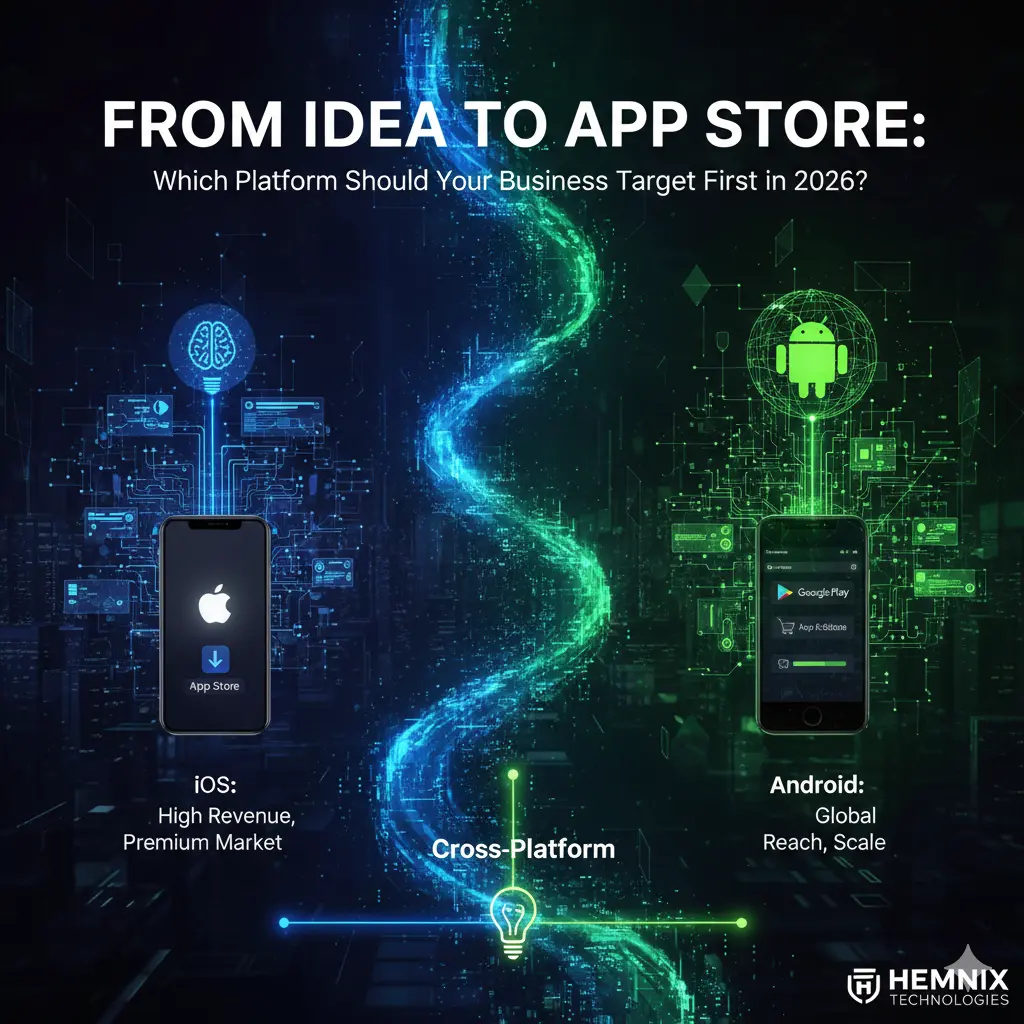
Your "Idea to App Store" journey in 2026 starts with a strategic decision based on your core business objectives:
If your primary goal is high revenue per user and you target Western markets, start with iOS.
If your primary goal is global scale and user acquisition in emerging markets, start with Android.
If you need to hit both markets quickly and efficiently on a budget, strongly consider a cross-platform approach.
At Hemnix Technologies, we guide businesses from napkin-sketch ideas to successful app launches. We'll help you dissect your vision, identify your target audience, and choose the most effective platform and technology stack for your 2026 success.
Ready to bring your idea to life? Let's discuss your project and chart the most cost-effective and impactful path to the App Store.