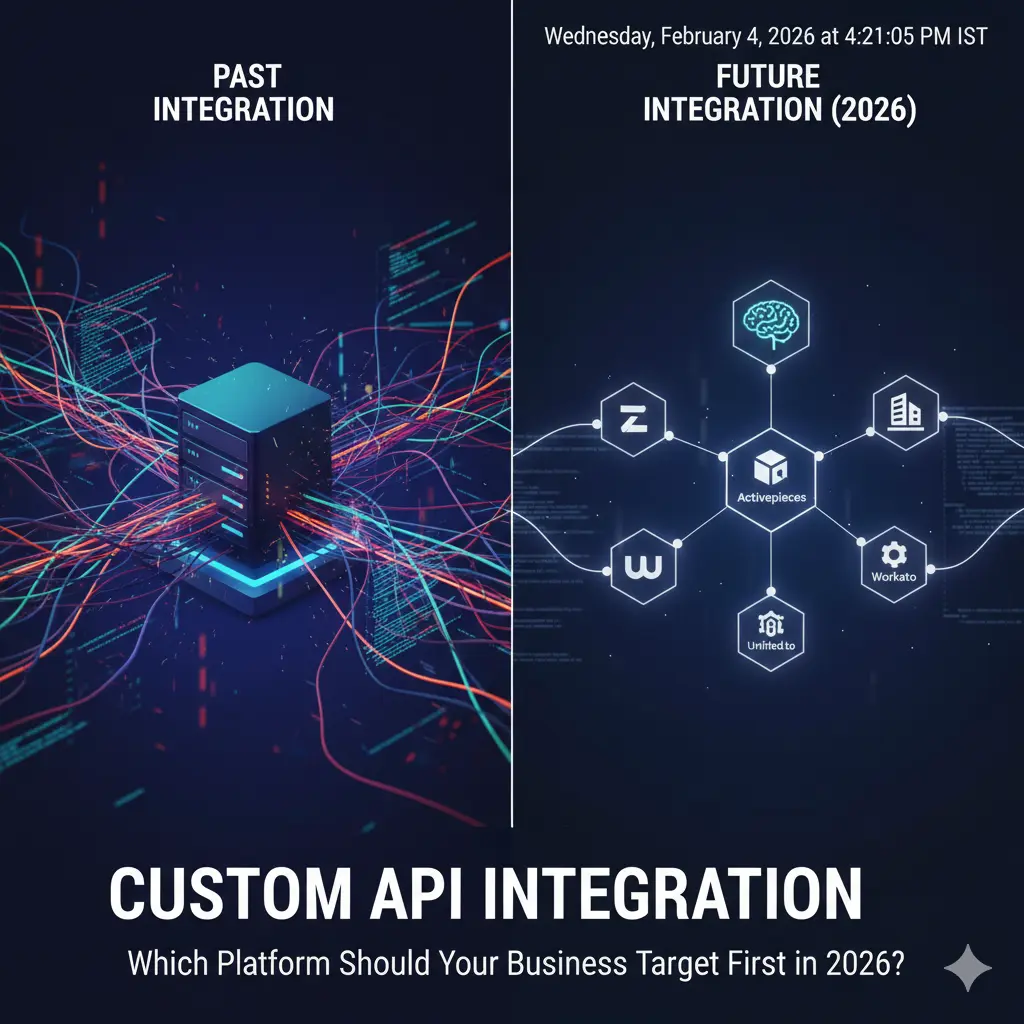
In 2026, the "API Economy" has evolved into the "Agent Economy." We are no longer just connecting App A to App B to move data; we are building the neural pathways for autonomous AI agents to perform complex business logic across our entire tech stack.
For business leaders, the stakes have never been higher. A poorly chosen integration platform in 2026 doesn't just result in "broken links"—it creates "hallucinating" AI agents and massive data security gaps. According to industry data, more than 30% of new API demand in 2026 is driven by AI tools and Large Language Models (LLMs) requiring real-time, structured access to business data.
The question is: Which platform should your business target first to ensure maximum ROI and AI-readiness?
The market has bifurcated into three distinct categories. Your choice depends on your business size, technical maturity, and whether you are building for humans or AI agents.
If your goal is to empower non-technical teams (Marketing, Sales, HR) to build "Agentic Workflows" without writing code, these are your targets.
Zapier (Central AI Hub): In 2026, Zapier has transitioned from simple "triggers" to a full-scale AI orchestration layer. With over 8,000 integrations, it is the first place businesses go to connect AI SDRs or automated customer support bots.
Activepieces (Open-Source Agility): This is the rising star for 2026. Because it is open-source, it offers a "middle ground"—the ease of no-code with the ability for developers to inject custom JavaScript for specialized logic.
Best For: SMEs, rapid prototyping, and AI-driven sales/marketing automation.
A major trend in 2026 is the Unified API. Instead of building 50 separate integrations for 50 different CRMs (HubSpot, Salesforce, Pipedrive), you integrate once with a unified provider.
Unified.to: Recognized as the top choice in 2026 for real-time data. It uses a "pass-through" architecture, meaning it doesn't store your sensitive customer data at rest—a massive compliance win for GDPR and HIPAA.
Bindbee (Vertical Specialized): If your business is in HR-Tech or Fintech, Bindbee is the target. It provides a single API for 60+ HRIS, Payroll, and ATS systems.
Best For: B2B SaaS companies that need to offer "integrations" as a feature to their own customers.
For large organizations with legacy on-premise systems and strict "Zero Trust" security requirements, the heavy hitters still reign supreme.
MuleSoft Anypoint: The gold standard for "API Governance." In 2026, MuleSoft is used as an AI Gateway, controlling which AI models can access which data fragments.
Workato: The leader in complex, multi-departmental enterprise automation. It handles high-volume data syncs (ETL) and API integration in a single, secure environment.
Best For: Fortune 500s, healthcare providers, and financial institutions with complex compliance needs.
Feature | Zapier / Activepieces | Unified.to / Bindbee | MuleSoft / Workato |
Setup Speed | Minutes | Days | Months |
AI Readiness | Very High (Pre-built) | High (Clean Data) | Highest (Governed) |
Data Privacy | Moderate | Excellent (Pass-through) | Industrial Grade |
Typical ROI | Immediate (Hours saved) | High (Engineering costs) | Strategic (Scalability) |
Export to Sheets
Regardless of the platform, the methodology has shifted to API-First Development. In this model, you design the "Contract" (the API specification) before you write a single line of application code.
Parallel Workstreams: Your frontend team, mobile team, and AI-agent team can all work simultaneously against a stable API contract.
AI-Crawlability: Well-documented APIs (using OpenAPI 3.1+) are now being "read" by AI coding assistants to generate client libraries and documentation automatically.
Reduced Technical Debt: By treating the API as a "product," you ensure that changing your backend database won't break the customer-facing app.
Where does your data live? If it’s mostly in modern SaaS apps (Slack, HubSpot), Zapier or Webflow integrations are sufficient. If your data is locked in a 20-year-old SQL database behind a firewall, you must target MuleSoft or a custom Node.js/PHP bridge.
In 2026, "Polling" (checking for changes every 5 minutes) is seen as archaic and expensive. Prioritize platforms like Unified.to that support Webhooks and event-driven architecture. This ensures your AI agents react in milliseconds, not minutes.
80% of API breaches in 2026 are still caused by simple misconfigurations. If your business handles PII (Personally Identifiable Information), you should prioritize platforms that offer Automatic Policy Enforcement—ensuring every new API call is encrypted and authenticated by default.
The "Evolution of API Integration" has moved from a technical chore to a competitive weapon.
Target Zapier/Activepieces first if: You need to automate internal business processes and want to give your team "AI Superpowers" today.
Target Unified.to/Bindbee first if: You are building a software product and your customers are demanding that you "sync" with their existing tools.
Target MuleSoft/Workato first if: You are managing a digital transformation for a large organization where security and data governance are non-negotiable.
In 2026, the most successful companies aren't the ones with the most apps; they are the ones with the most connected apps.
Would you like me to create a technical comparison of the security protocols (OAuth2 vs. JWT) used by these platforms to help your CTO make the final call?