In 2026, the digital wallet has evolved far beyond a simple "holding tank" for Bitcoin. It is now the primary gateway for identity, automated treasury management, and institutional-grade commerce. For businesses, choosing the right foundation for a wallet is no longer just a technical hurdle—it is a strategic decision that determines your security liability, user friction, and regulatory standing.
With the 2026 implementation of the GENIUS Act in the U.S. and established stablecoin frameworks in Europe and Asia, "building a wallet" now requires balancing cutting-edge cryptography with rigorous compliance.
If your business is looking to build its first secure wallet in 2026, here is the roadmap to choosing your target platform.
In 2026, the "seed phrase" is officially a legacy fallback. Modern businesses are building on two transformative technologies that solve the single biggest risk in crypto: the loss of private keys.
MPC (Multi-Party Computation): Instead of a single private key, the key is sharded into "shares" distributed across multiple locations (e.g., your server, the user’s phone, and a backup). No single piece can move funds, eliminating the single point of failure.
Account Abstraction (ERC-4337 and beyond): This turns a wallet into a smart contract. It enables "Social Recovery" (recovering funds via trusted contacts), gasless transactions (your business pays the user's fees), and "Session Keys" (allowing a bot to trade on the user's behalf for a limited time).
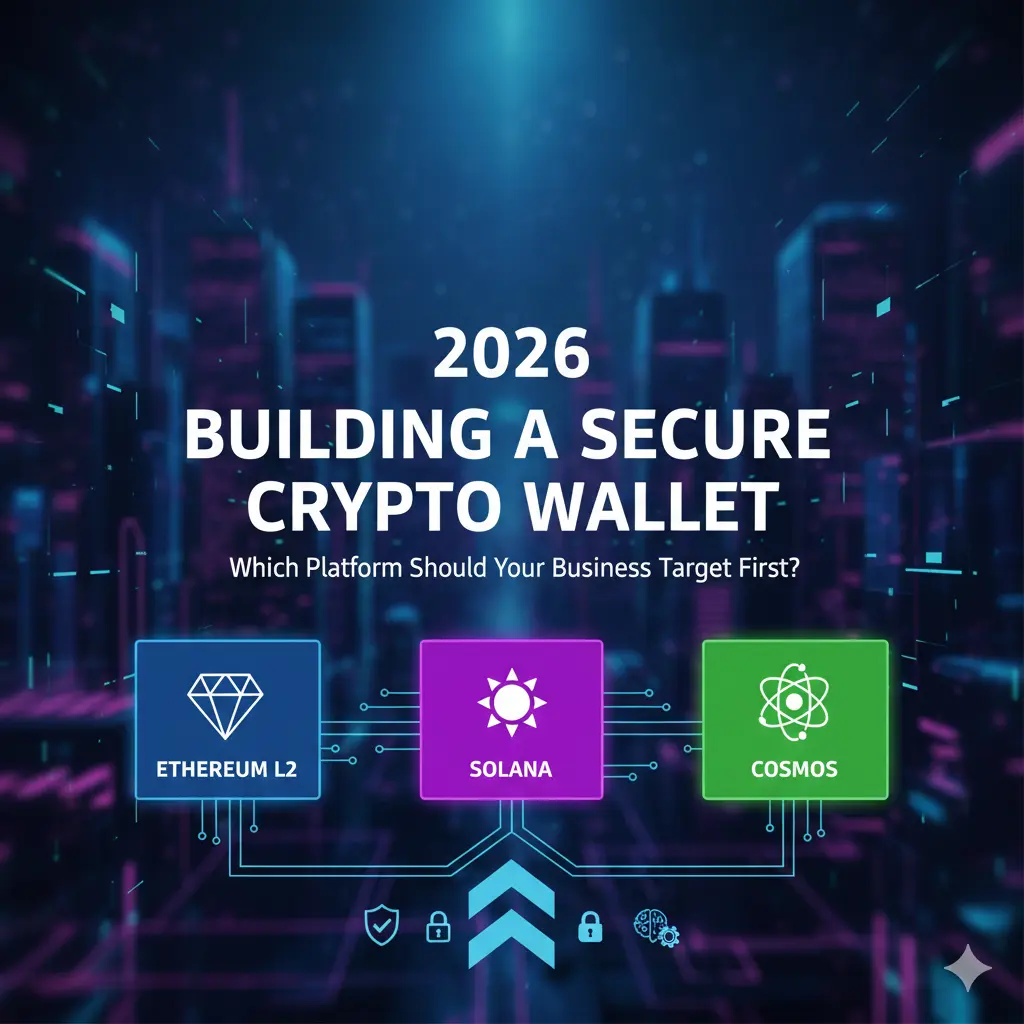
If your business targets Enterprise Treasury, Tokenized Real-World Assets (RWAs), or Regulated Finance, Ethereum’s Layer 2 ecosystem is your first target.
Why: By 2026, Ethereum’s "Modular" roadmap has moved execution to L2s while L1 handles massive security. This ecosystem has the most advanced Account Abstraction tools.
The Benefit: You get the security of the world's most decentralized network with the flexibility to build wallets that look and feel like banking apps.
Best For: Corporate payment rails, B2B settlement, and high-value asset custody.
If your business is building for Mass Retail, Gaming, or Autonomous AI Agents, Solana is the undisputed leader in 2026.
Why: With the Firedancer upgrade fully operational, Solana offers sub-second settlement and virtually zero fees. It is the only platform capable of supporting "AI Wallets"—wallets that allow AI agents to transact millions of times per day.
The Benefit: Solana’s mobile-native stack (via the Saga ecosystem) makes it the easiest platform for building "embedded wallets" that sit invisibly inside a mobile app.
Best For: Micro-payments, loyalty programs, social media tipping, and AI-driven commerce.
For businesses that need absolute control over their infrastructure (like a bank or a government entity), the Cosmos SDK is the target.
Why: It allows you to build your own "App-Chain." You aren't just building a wallet on a network; you are building a network for your wallet.
The Benefit: You can enforce your own KYC/AML rules directly at the validator level, ensuring every transaction in your wallet is compliant with local laws.
Best For: Central Bank Digital Currencies (CBDCs), private banking networks, and highly regulated logistics.
Feature | Ethereum L2s | Solana | Cosmos |
Primary Strength | Security & Compliance | Speed & Consumer UX | Sovereignty & Customization |
Recovery Method | Account Abstraction | MPC & Biometrics | Protocol-Level Logic |
Avg. Fee | $0.01 - $0.05 | < $0.001 | Custom / Variable |
Target User | Institutional / Finance | Retail / AI / Gaming | Government / Enterprise |
Export to Sheets
Regardless of the platform, a 2026-ready wallet must include:
Compliance Hooks: Real-time screening that blocks transactions to or from blacklisted (OFAC/AML) addresses.
MPC-based 2FA: Moving beyond SMS codes to cryptographic key-sharding for all large transfers.
Encrypted Cloud Recovery: Allowing users to back up their key shards to services like iCloud or Google Drive without compromising security.
Transaction Previewing: Visual tools that show exactly what a smart contract will do before the user clicks "sign."
To decide where to start, identify your business's "Priority Zero":
If "Trust" is your product: Start with Ethereum Layer 2s (specifically Base or Arbitrum). They offer the most established legal and technical safeguards.
If "Ease of Use" is your product: Start with Solana. The low fees and high speed are essential for keeping users from abandoning the app.
If "Regulatory Control" is your product: Start with Avalanche Subnets or Cosmos. They give you the "off" switch and data privacy that public chains lack.
The most successful crypto wallets in 2026 don't feel like crypto wallets at all. They feel like secure, modern digital accounts where "blockchain" is just the invisible plumbing. By leveraging MPC and Account Abstraction on a platform like an Ethereum L2 or Solana, your business can provide the security users need with the simplicity they demand.
Would you like me to create a technical security checklist for your developers based on the MPC/Account Abstraction model?